 Tattoos welcome
Konohana no Yu
Day bath, Gotemba
- Where
- Outlet mall grounds
- Also
- 19 private baths
- On our tour
- A possible last stop
Guides
Language
EnglishCurrency
US dollar · $Your currency applies on GetYourGuide too.
Guide · Etiquette
Onsen etiquette is simple once someone walks you through it, and the tattoo question has clearer answers near Mount Fuji than most guides admit. Here are the steps, the rules bath by bath, and your options with ink.
Editorial team, mountfujionsen.comUpdated October 23, 2026read in 6 minutes33 sources
The rules, briefly
An onsen is shared water. Everyone soaks in the same bath, often in silence, and the rules exist to keep that water clean and that silence intact. JNTO, Japan's national tourism organization, sums up the core of it in a handful of points: undress fully, wash before you get in, keep towels and hair out of the water, speak softly and leave your phone outside.1237
None of it is hard, and staff and other bathers are usually patient with first-timers. The mistakes that do cause a stir are the obvious ones: getting into the bath unwashed, swimming, or holding a phone. Avoid those and you will be fine. Watch what the people around you do for the first minute, copy them, and you will learn the rhythm of the place faster than from any guide.
The tattoo question is different, because it is not about manners at all but about each bath's house rules. Those rules vary from one building to the next, even on the same street, and a bath has every right to apply its own. The good news is that near Mount Fuji the main baths state their rules clearly.
Step by step
At the door
Into a locker before the changing room.8
Changing room
Swimwear stays behind; take the small towel.1
Washing area
Soap, shampoo, then a full rinse.2
Bath edge
Pour hot water over yourself to adjust.9
In the water
Leaving
Wipe down before the changing room.11
Take your shoes off at the entrance and put them in a locker; shoes never go into the changing room.8 Look for the curtains marked 女 for women and 男 for men, since changing rooms are always separated by gender, as are most of the baths themselves.1213
In the changing room, everything comes off, swimwear included, and goes into a locker or basket.1 Take only the small towel with you. Sit at a washing station, wash with the soap and shampoo provided, and rinse off completely.2 Then pour some hot water from the bath over your body, a custom called kakeyu that lets you get used to the heat.9
Ease into the water slowly. Fold the small towel and rest it on your head or on the edge of the bath, and tie up long hair.310 Afterwards, whether to rinse off the onsen water is up to you; many people leave it on their skin.14 Dry off a little before going back into the changing room so you do not drip on the floor. Stay in for short spells and take breaks on the edge or in the rest room; the water can feel hotter than a bath at home, and there is no prize for lasting longest.
Tattoo rules
| Bath | Area | Tattoos | Covers |
|---|---|---|---|
| Konohana no Yu day bath | Gotemba | Welcome | Not needed |
| Yurari day bath | Narusawa | Not allowed | Sticker not accepted |
| Fuji Hakkei no Yu day bath | Gotemba | Not allowed | Not stated |
| Fujiyama Onsen (closed) | Fujiyoshida | Pages disagree | Its own stickers, per FAQ |
| Benifuji no Yu day bath | Yamanakako | Not allowed per a tour | Bandages, per that tour |
From each bath's own pages, Odakyu's guide and tour listings; rules change, so confirm before you go.4561516
With a tattoo
Tattoos welcomeDay bath, Gotemba
 Bathe alone
Kashikiriburo or room tub
 Ask first
Small tattoos only
Decision helper
Find your situation in the left column
The listing names it as the bath that admits tattoos.
JNTO says cover sheets generally suit only very small tattoos.17
Ubuya lists a private open-air bath in several room types.18
Bathing is refused, but the restaurant and massage are open to you.5
You may be able to get into an onsen that doesn't allow tattoos if you can cover your tattoos with some sort of sticker or patch, though it is best to check with the facility in advance about whether this is okay or not.
Do not bring a phone or camera into the bathing area. JNTO calls it absolutely forbidden, out of respect for other bathers' privacy and children's in particular.20 This rule is the one that most often catches visitors at baths with a famous view, so take your photos of the mountain from a rest room or a terrace.
Do not swim, splash or talk loudly, and do not drink alcohol before bathing, which JNTO warns can affect your judgment.721 Do not wash clothes or your towel in the bath, and never let the towel touch the water.3 If you need to cool off, sit on the edge for a while rather than leaving the room in a rush. Keep a bottle of water in the changing room and drink between soaks.
Children follow local rules too. In Yamanashi Prefecture, an ordinance bars children aged 7 and over from the bath of the other sex, which shapes how a family splits up at the door.22 Younger children are welcome at many baths, but check each bath's rules on diapers and small children in advance.23
Checklist
Video
The player loads on your tap, not before.
JNTO explains the taboo plainly: tattoos in Japan are associated with members of organized crime, and baths ban them so that other guests do not feel uneasy.24 The rule says nothing about you; it is a blanket policy, and staff apply it without asking about the meaning of your tattoo.
The picture is changing slowly. JNTO cites a 2015 study by the Japan Tourism Agency in which about 30 percent of hotels and inns said they would allow someone with a tattoo to use their communal baths.25 In a notice of 16 March 2016 to the hotel, ryokan and hot spring associations, the agency wrote that refusing a bath solely because of a tattoo is not appropriate.26
The agency did not order baths to admit tattoos. It asked them to consider its examples: covering a tattoo with a sticker, no special measures for small tattoos that do not intimidate, bathing at hours with few families, and guiding guests to private baths.272829 It also noted that a tattoo causes no hygiene problem.30
The clearest yes is Konohana no Yu, the day bath in the grounds of Gotemba Premium Outlets. Odakyu's guide states that guests with tattoos are welcome, and the listing of our day trip says the same: Konohana no Yu admits tattoos, while the other hot springs on the tour do not.4
The clearest no comes from Fuji Chobo no Yu Yurari in Narusawa, which refuses bathing to anyone with a tattoo even when it is covered with a sticker, though tattooed guests may still use its restaurant and massage.5 Fuji Hakkei no Yu in Gotemba also refuses bathing to people with tattoos.6
Fujiyama Onsen in Fujiyoshida is closed for now, and its own pages disagree: the FAQ admits tattoos fully covered by up to two of its cover stickers, while the rules page refuses tattoo stickers.311516 One tour to Benifuji no Yu at Lake Yamanaka says tattoos are not permitted there, but that bandages or a private bath for a fee are possible.
First, a bath that says yes. Near Fuji that means Konohana no Yu, which is also one of the possible last stops on the day trip sold here.4 If you book that tour, tell the guide in the morning that you want that bath, since the hot spring stop is a group choice.
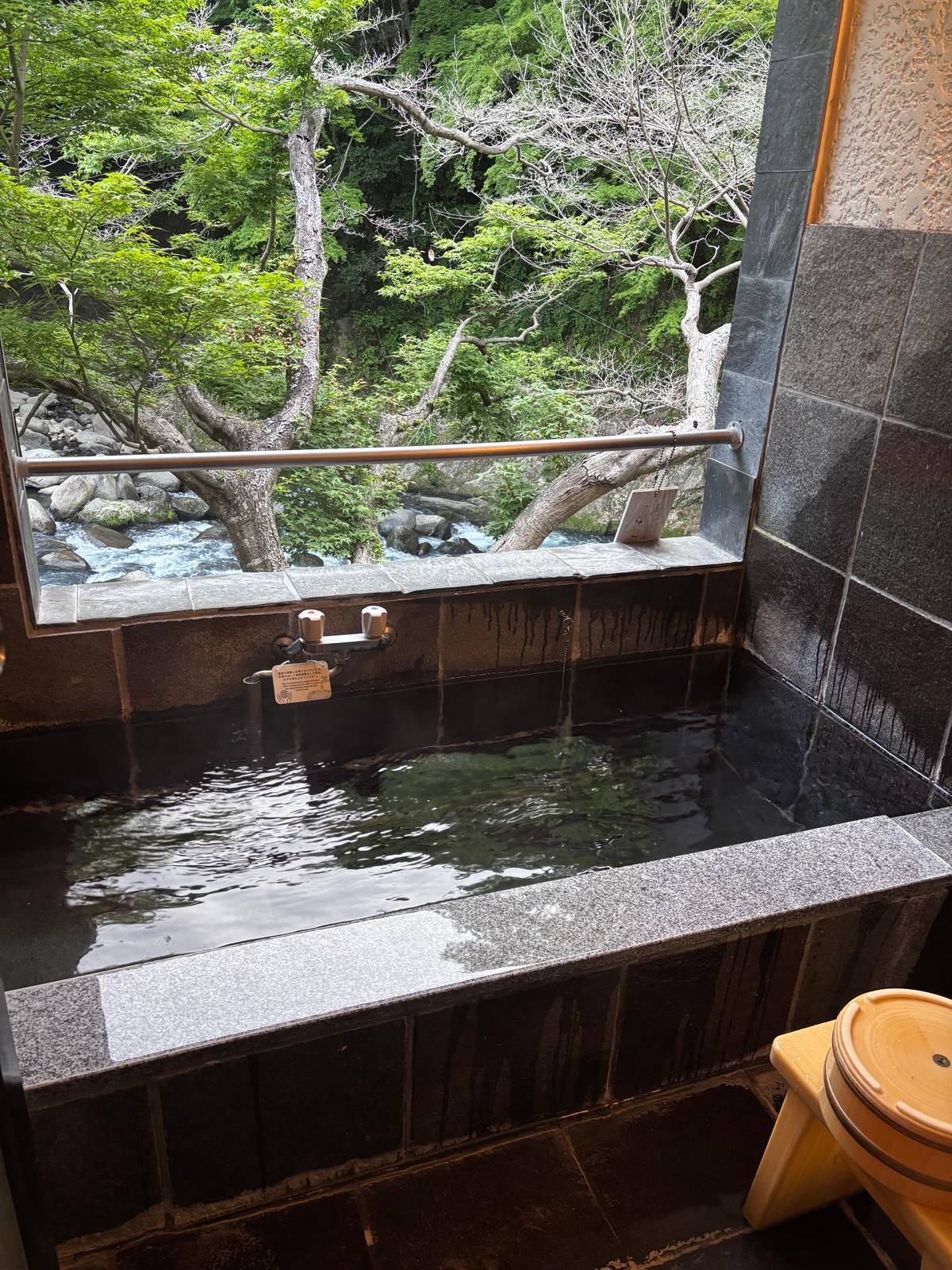
Second, a private bath. JNTO's own advice is to look for tattoo-friendly places or book a kashikiriburo, a private bath you use alone.32 Konohana no Yu has 19 private open-air baths, and many ryokan around Lake Kawaguchi have rooms with their own open-air tub.3318
Third, a cover. JNTO notes that many baths sell small tattoo cover sheets, but that they generally suit only very small tattoos, and that it is best to check in advance whether a cover is accepted.1719 At Yurari a sticker does not help; at baths that accept one, carry a few of your own and ask before you undress. Whatever route you take, a calm, polite question at reception goes much further than an argument once you are already undressed.
Tour listings state their rules too, and they differ. A private Hakone day trip says that every onsen it visits is tattoo friendly. A private Fuji day trip that ends at Konohananoyu labels its onsen tattoo-friendly.
A ski day from Tokyo with an onsen option warns that entry to the hot springs may be restricted if you have tattoos. That is the honest wording you will see on most listings: the operator does not run the bath, so it cannot promise you entry. The same caution applies to any tour whose bath is run by someone else.
Read the good-to-know section of any tour before you book, and if it says nothing, ask the operator through the booking page. A clear answer in writing beats an awkward conversation at a reception desk while the rest of the group waits.
Your Fuji day
Pick a date, meet at Tokyo Station or in Shinjuku, and cancel free of charge right up to 24 hours before.
Yes. Onsen bathing is typically done in the nude, and swimwear stays in the changing area.1
Konohana no Yu in Gotemba. Odakyu's guide and our day trip's listing both say tattooed guests are admitted.4
No. Yurari refuses bathing with a tattoo even when it is covered with a sticker.5
No, it is each bath's decision. The tourism agency calls refusal solely for a tattoo inappropriate, but left the response to each bath.2627
No. JNTO says phones and cameras are absolutely forbidden in an onsen to protect privacy.20
Under 7 only in Yamanashi. A Yamanashi ordinance bars children aged 7 and over from the bath of the other sex.22
It is your choice. JNTO says many leave the onsen water on their skin, while others rinse once more.14
Sources
Keep reading